
Best Dice for Dice Art: The Complete 2026 Buyer's Guide
Dice mosaic art is having a moment — but here is the uncomfortable truth most tutorials skip: most beginners buy the wrong dice. Random bulk bags from a game store might look fine in the product photo, yet slight size drift, off-white plastic, and inconsistent edges can turn a promising design into a lumpy, noisy mess. The good news is that once you know what to look for, choosing dice for your next project becomes straightforward.
This guide is written for anyone who wants dice mosaic supplies that actually match how the art form works: consistent grid, predictable contrast, and honest math when you order in bulk. We will compare two common sourcing paths — bulk game dice versus precision dice for art — and walk through 10mm dice for dice art (the size most professionals quietly standardize on), uniform size dice requirements, and black white dice mosaic basics. Along the way, you will see where bulk dice for crafts make sense — and where they cost more time than they save.
If you are new to the workflow, start with our Dice Art Generator tutorial — a full walkthrough from upload to blueprint download; then come back here when you are ready to source materials like a pro.
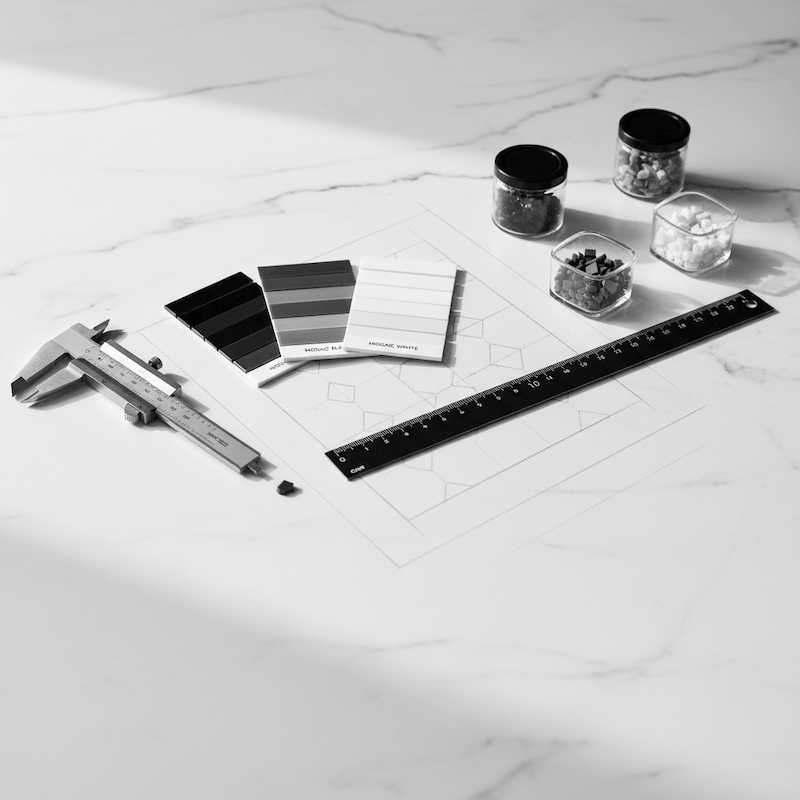
Why Dice Quality Matters for Mosaic Art
Dice art is pixel art in three dimensions. Each die is one cell in a grid; your image is “sampled” into that grid, usually mapped to grayscale levels that correspond to dice faces (typically 0–6 pips). When the physical dice do not match each other, the grid breaks: gaps vary, surfaces do not line up, and the eye reads the flaws before it reads the portrait.
Size consistency is the foundation. Even tiny deviations compound across thousands of placements. Uneven spacing reads as visual noise; uneven stacking can make a panel warp when glued; and when you estimate how many dice you need, tolerance stacks turn your order into a guessing game.
Color accuracy is just as important for monochrome builds. Black white dice mosaic work depends on clean contrast between deep blacks and clean whites. Speckled, yellowed, or marbled plastics introduce accidental texture — it looks like static on a photograph.
The hidden cost of cheap dice is not the sticker price; it is rework, wasted adhesive, and hours spent compensating for bad materials. For anything you plan to frame, gift, or sell, materials are the wrong place to cut corners.
Glue-up strategy interacts with tolerance, too. Thinner gaps emphasize size error; thicker adhesive lines can hide small variance but soften the image slightly. Most builders eventually settle on a repeatable spacer or alignment method — a jig, a printed backing grid, or strip-built rows — and uniform size dice make every technique more predictable. If you have ever watched a mosaic “creep” out of square halfway across a board, you have seen tolerance debt in action.
Types of Dice for Art Projects Compared
Not all six-sided dice are interchangeable. Here is how two common sources compare in real projects.
Standard Game Dice (Bulk)
Standard bulk dice for crafts — the kind sold by the pound for tabletop games — are easy to find on major marketplaces and local shops. They are tempting when you want to prototype fast.
Pros
- Low cost per die (often roughly $0.01–0.05 in large bags)
- Wide availability and fast shipping from many retailers
- Multiple sizes (12 mm and 16 mm are common)
Cons
- Loose tolerances (±0.5 mm or worse is common across mixed batches)
- Color inconsistency, even within one bag
- Mixed mold ages can mean slightly different corner radii and face finishes
- Plastics vary; some yellow with age or chip when handled
Best for: practice grids, teaching demos, or low-stakes experiments.
Verdict: cheap up front, expensive in time — finished pieces often look uneven under light.
Precision Art Dice (Specialized)
Precision dice for art are a different product category from random hobby bags: designed for mosaic-scale builds, sold with predictable sizing, and offered in the monochrome palettes algorithms assume.
What to expect
- Controlled tolerances (often around ±0.1 mm — tighter than typical mixed-batch game dice, at a price point suited to large mosaic projects)
- Batch-consistent black and white options for uniform size dice grids
- Corners and faces suited to tiling and adhesive, not casual tabletop gaming
One example of this category is the DiceArt.me precision line: 10mm dice for dice art layouts, injection-molded for repeatability, priced for bulk projects rather than small souvenir orders. It is the profile most serious creators adopt once they move beyond experiments — not because marketing says so, but because the build stops fighting the materials.
Best for: portraits, home decor, gifts, commissions, and any piece you want to look intentional from arm’s length and up close.
Verdict: the practical sweet spot for dice mosaic supplies when quality and budget must coexist.
| Feature | Game Dice (Bulk) | Art Dice (Precision) |
|---|---|---|
| Typical size precision | ±0.5 mm or worse | ±0.1 mm |
| Approx. price per die | $0.01–0.05 | $0.02–0.08 |
| Color options | Many but uneven | Pure black / pure white |
| Best use case | Practice, prototypes | Professional builds, display |
If you are ready to work with materials tuned for mosaics, see our precision dice on DiceArt.me →.
What Size Dice Should You Use?
10mm Dice — The Sweet Spot
For most creators, 10mm dice for dice art are the default for good reasons:
- Balance: enough resolution for facial detail without making every square foot absurdly heavy
- Handling: comfortable to pick and place for long sessions
- Math: dice totals and finished size follow the generator’s width × height (in dice), then multiply each axis by die edge length — no separate inch-density guesswork
- Shipping and storage: more manageable than large dice at the same finished dimensions
Rating: ★★★★★ for portraits from about 8"×10" upward, logos, and wall art.
12mm Dice
Twelve-millimeter dice cover about 44% more area per die than 10 mm. Builds go faster and read well from a distance, but fine detail softens. Use them when the viewing distance is meters, not inches — large wall pieces and bold graphic designs.
16mm+ Dice
Standard game size dice are common in bulk bags, but each cell is huge relative to a photograph. You lose nuance quickly; fine portraiture rarely survives. Reserve these for very large installations, playful kids’ workshops, or intentionally chunky aesthetics.
Summary: if you want a professional baseline, plan around 10mm dice for dice art unless the brief clearly calls for a bolder grid.
Color Selection Guide
Black vs White — When to Use Each
Monochrome mosaics are not “colorless”; they are contrast management.
- Black dice anchor shadows, hair, clothing, and background depth — especially on pieces mounted on light walls where you want the image to feel carved from darkness.
- White dice carry highlights, skin luminosity, and sky — and they pop against dark backings.
Most portraits lean heavily one direction: it is common to need roughly 80–90% of one tone and 10–20% of the other, depending on exposure and subject. Your generator preview is the truth test; your dice mosaic supplies should match that distribution without surprise texture.
Why Pure Colors Matter
Mottled or recycled plastics read as speckle — effectively image noise. For gallery-level work, insist on clean surfaces and buy a sample batch before committing to thousands. If two bags look like different products, they will behave like different products on the wall.
How Many Dice Do You Need?
Order quantity is where bulk dice for crafts math becomes real. Treat the blueprint generator as the source of truth: do not guess totals from inches alone.
In the DiceArt generator, the grid is shown as width × height in dice count — not centimeters or inches. The total number of dice is:
width (dice) × height (dice) = total dice
For example, 90 dice wide by 120 dice tall = 90 × 120 = 10,800 dice. The tool also shows the total directly; use the on-screen numbers when you order materials.
Finished physical size (approximate, without counting glue gaps) is:
- horizontal span ≈ width (dice) × die edge length
- vertical span ≈ height (dice) × die edge length
So a 90 × 120 layout with 10 mm dice is roughly 900 mm × 1200 mm (90 × 10 mm by 120 × 10 mm). If you use 12 mm, 16 mm, or another edge length, substitute that value for 10 mm in the same formula.
Summary: the dice count comes from the generator’s width × height; you convert that to real-world dimensions by multiplying each axis by your chosen die size. Add extra spare dice (often around +10%) if you expect breakage, test rows, or a long glue-up. For commissions, keep an extra sealed bag from the same lot for future repairs — plastic dye lots can drift slightly, and planning ahead is cheaper than color-matching later.
Where to Buy Dice for Art Projects
Online Retailers — What to Expect
Large marketplaces (Amazon, AliExpress, etc.) offer speed and price competition — but there are countless sellers at wildly different quality levels. Two listings can look identical yet ship from different factories, so batch-to-batch consistency is a gamble. Published specs rarely mention dimensional tolerance, and returns are painful once you have opened kilograms of plastic.
Specialty suppliers cost more per inquiry but can answer questions about molds, UV stability, and lot matching — worth it for paid commissions.
DiceArt.me focuses on dice mosaic supplies for creators: monochrome precision dice sized for typical grids, with pricing meant for whole projects rather than souvenir quantities. If your goal is predictable uniform size dice at mosaic scale, a specialist catalog beats a random bulk gamble.
Creators often tell us the deciding factor was not marketing copy but repeatability — receiving a second order that matches the first. That is exactly what dice mosaic supplies should optimize for, and it is why we emphasize batch-consistent black and white stock, careful packing to reduce edge chipping in transit, and clear quantity tiers so you can align purchases with your blueprint.
What to Look for When Buying
- Published size spec or tolerance language — not just “standard”
- Reviews that mention consistency and color, not only price
- A small sample order before a large one
- Spot-check size and finish on a sample batch before full glue-up
- Realistic freight expectations — weight adds up fast
For product specifics and packs, visit our dice shop.
Our Top Pick for 2026
Across cost, repeatability, and availability in true black and white, precision art dice win for most readers of this guide. Generic bulk bags are a lottery. Precision dice for art give you controlled tolerances, sane pricing at volume, and materials that match how software maps photographs to dice faces.
Reasons we recommend this class in 2026:
- Value curve — fewer wasted materials and rework than rolling the dice on mixed bulk bags
- Purpose-built — corners and finishes meant for tiling, not casual tabletop use
- Batch sanity — easier to reorder when you expand a series
- Skill range — forgiving enough for motivated beginners, serious enough for pros
Next step: browse precision dice for dice mosaic projects and pick a pack that matches your preview counts.
Frequently Asked Questions
Can I use regular D6 game dice for dice art?
Yes — technically. For quality work, we do not recommend relying on mixed game dice: size drift, color noise, and face wear show up as defects in the final piece. Use them for practice; use precision dice for art when the result matters.
What is the difference between standard game dice and art dice?
Bulk game dice are cheap and easy to find, but tolerance and color can vary bag to bag. Art dice are sold for controlled tolerances and stable black-and-white batches — a better match for blueprint-driven, large-surface builds.
How should I store bulk dice?
Split by color into sealed bags, label counts, and keep them out of direct sun and damp basements. UV and humidity are the enemies of long-term plastic consistency.
Do you offer wholesale pricing?
DiceArt.me does not publish separate wholesale tier pricing. Prices are already aimed at bulk mosaic projects, and overall value is strong. See the purchase page for current pack sizes and pricing.
Ready to Start Your Dice Art Project?
Choosing the best dice for dice art is half the battle; the other half is a clean preview and a patient build. Investing in uniform size dice and honest monochrome plastics saves more frustration than any single tutorial tip.
Start here:
- Shop precision dice — materials sized and sold for mosaic work
- Read the Dice Art Generator tutorial — photo selection, parameters, and blueprint download
- Open the generator — see live dice counts and grayscale mapping for your image
- Browse the gallery — real projects for scale and inspiration
Further reading: for background on dice history and manufacturing, see Wikipedia — Dice. Product specifications follow the DiceArt.me pages at time of publication.