
Dice Portraits: A Truly Unique Custom Birthday Gift for Family and Friends
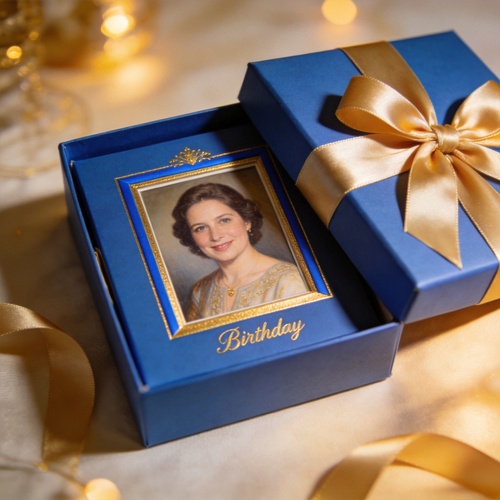
Every year, the same question comes around: what do you give someone that actually means something? Something thoughtful, something personal — something that won't end up forgotten in a drawer three weeks later.
More and more people are finding an unexpected answer: a dice portrait.
It's not something you pull off a shelf. It's a photograph you both treasure, recreated from hundreds or even thousands of dice into a piece of wall art you assembled yourself. The texture, the handmade warmth, the quiet message of "I made this specifically for you" — no mass-produced gift can come close to that.
Why Dice Portraits Work So Well as Birthday Gifts
Every great birthday gift faces the same challenge: it needs to prove you know the person. An ordinary gift says you care. A truly great gift says you understand.
Dice portraits succeed at birthdays because every element can be deeply personal.
It comes from a real memory. The photo you choose might be their childhood smile, a trip you took together, or the moment they were most themselves with a beloved pet. Turning a specific memory into something tangible sends a clear message: "This moment mattered to me. I want you to keep it too."
It's genuinely one of a kind. No two dice portraits are identical, because no two photos are the same. Whatever arrives in that box belongs to exactly one person in the world.
It has real visual impact. Up close, a dice portrait is a grid of tiny numbered faces. Step back, and a full human portrait emerges. That dual experience — detailed texture at arm's length, recognizable likeness from across the room — stops everyone who sees it for the first time.
It shows how much effort you invested. Whether it was finding the right photo or spending a whole afternoon placing each die, the effort is part of the gift itself. The underlying message is: you were worth this much of my time.
How to Choose the Right Photo
Photo selection is the single most important decision in the entire process.
Not every photo translates well into dice mosaic form. A good dice portrait needs a source image with clear contours and rich tonal gradation. Here's what to look for:
Photos That Work Well
Portraits with a clear subject and a clean background. A solo headshot or half-body photo works best. The subject should fill most of the frame, the background shouldn't compete for attention, and the facial expression should be natural and relaxed.
Photos with even lighting and balanced contrast. Natural outdoor light usually produces excellent results. You want the face evenly lit with gentle shadows — not dramatic backlighting that plunges half the face into darkness.
Photos tied to meaningful moments. A trip, a graduation, a family gathering — a photo that carries context becomes more than a portrait once rendered in dice. It becomes a story.
Black-and-white or vintage photos. Dice art works by converting images to grayscale, so black-and-white photos are a natural fit. They often produce results with a cinematic, timeless quality. Old family photos are especially worth trying.
Photos to Avoid
Blurry or low-resolution images. The detail in a dice mosaic depends entirely on the source image. A blurry photo will lose even more information in the conversion and become hard to recognize.
Strongly backlit shots. Silhouettes may look dramatic as photos, but they contain almost no facial detail, and the result in dice form will be flat and illegible.
Group shots where every face is small. If individual faces are tiny in the original photo, they'll be impossible to read at dice-mosaic scale. Stick to photos with fewer subjects and a clear focal point.
Photos with very busy backgrounds. A cluttered background fights the subject for visual attention and reduces overall legibility.
A Quick Practical Test
Shrink the candidate photo to about a quarter of its normal size on your phone screen. Can you still clearly identify the subject? If yes, the photo will likely work well. If the subject becomes unrecognizable at small size, find a sharper image.
What to Keep in Mind During Assembly
Generating the dice mosaic blueprint on DiceArt is the easy part: upload a photo, choose a size, preview the result in real time, download the placement guide. The patience comes with the physical assembly that follows. A few things will make a real difference:
Choosing the Right Size
The size of a dice portrait is measured by the number of dice used, which directly affects how much detail the final piece shows and how large it will physically be.
For a first attempt as a birthday gift, a medium size (around 1,000 dice) is the most balanced choice — detailed enough to be impressive, large enough to make an impact on a wall, and completable within a weekend.
For someone very important — a parent, a long-time best friend — a larger size is worth the extra effort. The final result will be genuinely stunning.
Keeping Die Orientation Consistent
The most common assembly mistake is inconsistent die orientation. All dice should face the same direction — typically with the "1" face pointing up as the baseline. Dice have a subtle surface sheen, and misaligned orientations create visible reflective differences under different lighting conditions.
Using the Right Amount of Glue
When using a hot glue gun to fix dice to the backing board, less is more. A small drop is enough. Too much glue overflows and sticks to the face of the die, which ruins the look. If you're not used to hot glue, practice on a spare piece of wood first to find the right amount and rhythm.
Pacing Yourself
Don't try to finish a large portrait in one sitting. Break the blueprint into sections and photograph your progress after completing each one. Extended work sessions cause eye fatigue, which leads to misplaced dice. If you catch a mistake while the glue is still warm, gently pry the die up and reposition it. Fully cured glue can be softened with a hair dryer.
The Assembly Process Is Part of the Gift
Here's something many people don't realize until they've done it: spending several focused hours placing each die one by one, watching a familiar face slowly emerge from a grid of dots — that experience means something. You're spending real time with that memory. When you finish, the sense of completion and emotional connection becomes an invisible but genuine part of the gift itself.
Presentation and Packaging
The dice portrait is already a substantial gift on its own. But thoughtful presentation makes the entire gifting moment feel complete — so that the act of opening it carries the same weight as the object inside.
Frame It Before You Give It
Framing is strongly recommended — and doing it before presenting the gift creates the best first impression.
Choose a frame slightly larger than the portrait, leaving a comfortable border of space around it. A wood frame feels warm and personal; a black metal frame feels modern and clean. Both work well.
If budget allows, add a transparent acrylic panel over the dice. It protects against dust and prevents any dice from loosening during transport.
When the recipient lifts the framed piece out of the gift box, they see the complete work immediately. That first-sight impact is everything.
The Gift Box
Avoid boxes that are too tight — they'll press against and warp the frame. Use a slightly oversized rigid gift box, or a sturdy art-carrier bag. Nest the piece in crinkle paper or velvet fabric inside the box to keep it secure and add a sense of occasion when opening.
Include a Handwritten Card
This is the one part of the gift you absolutely cannot skip.
Write a few sentences explaining why you chose this particular photo, or what the assembly process felt like. It doesn't need to be long. Something like:
"When I saw this photo, I thought of the day we were at ___. I wanted you to always have that moment."
Those few lines will make the recipient look at the dice portrait again — this time through the lens of their own memories and feelings.
Tell Them You Made It
In the card, or in person when you hand it over, mention that it was assembled by hand — how many dice it took, how long it took you.
That detail alone is moving. When someone learns you spent an entire afternoon or even a full weekend on their gift, their perception of the object completely changes. It's no longer just a striking piece of décor. It's evidence of how much they matter to you.
Care Instructions
Let the recipient know how to keep it in good condition: hang it indoors away from prolonged direct sunlight, which causes fading, and away from damp environments, which can warp the backing. If it's displayed without a frame, a light dust cover works fine.
A well-cared-for dice portrait will last for decades. Unlike flowers that wilt or food that expires, it will always be there — and every time they look at it, they'll think of you.
Start with a Photo
Open your camera roll. Find the picture that makes you think: this is them.
Maybe it's a candid laugh they don't know you captured. Maybe it's the two of you at an event you'll both always remember. Maybe it's an older photo going slightly yellow at the edges — waiting to become something else entirely.
Upload it at DiceArt.me, preview the dice mosaic result in real time, and download the placement guide when you're ready. The preview is completely free — you can see exactly how it will look before committing to anything.
The hardest part of a birthday gift isn't the cost. It's the proof that you really thought about it. A dice portrait is one of the best ways to show that.